
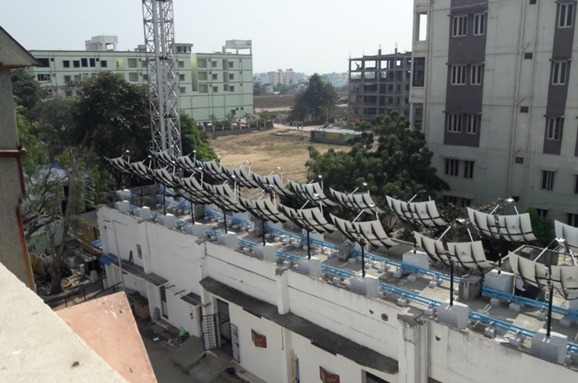
Beyond the Panel: The Rise of Solar Hot Water Generators for Large-Scale Applications
For decades, solar energy has been synonymous with photovoltaic (PV) panels—sleek, silent generators of electricity. But while the world focuses on electrons, a parallel revolution is heating up in the thermal space. Across the globe, industries, hotels, and even district heating systems are turning to. Solar hot water generators not just to save on electricity bills, but to tackle their largest energy expense: heat.
Industrial heat accounts for a staggering portion of global energy consumption, with some estimates suggesting industry alone represents up to 37% of total energy use . From pasteurizing milk and drying paper to cleaning equipment and pre-heating boiler feedwater, thermal energy is the unsung hero of the modern economy. Enter the next generation of large-scale solar thermal technology—solutions designed to integrate directly into industrial processes and commercial infrastructure.
Here is how innovators are scaling up solar hot water generation to meet the demands of the 21st century. Solar Hot Water Generators for Large-Scale Applications.
The Evolution of Collectors: From Rooftops to Heavy Industry
Traditional solar water heating has been a mainstay for swimming pools and domestic use for decades, typically operating below 60°C . However, large-scale applications require higher pressures, higher temperatures, and absolute reliability.
Modern systems are rising to this challenge. Companies like Calgary-based SolarSteam have re-engineered the parabolic trough for the industrial environment. By enclosing mirrors in a transparent protective shell, their “Obelix™” modules eliminate performance losses from wind, hail, and soiling. These units can deliver heat up to 320°C, making them viable for heavy oil, chemical processing, and food production .
Similarly, European innovators are pushing the envelope with High Vacuum Flat Panels (HVFPs). Unlike conventional flat plates, these panels can generate pressurized hot water up to. 150°C without losing efficiency, allowing them to slot directly into existing industrial heating networks .
The Hybrid Advantage: Co-Generation (PV-T)
One of the most exciting developments in the large-scale market is the rise of hybrid Photovoltaic-Thermal (PV-T) technology. These systems effectively have their cake and eat it too: they generate electricity while simultaneously cooling the panels to produce usable heat.
Michigan-based PowerPanel is a prime example of this trend. Their Gen20 system, recently boosted by a $5 million U.S. Department of Energy grant, effectively produces four times the energy output of a standalone PV or thermal panel .
By generating electricity and hot water from the same footprint, PV-T is a game-changer for sites with limited roof space, such as hotels, hospitals, and multi-unit residential buildings. These systems are particularly effective at supplying large volumes of low-to-medium temperature heat (for laundry or sanitation) while offsetting expensive retail electricity rates .
System Integration and Smart Controls
Installing a solar thermal array is only half the battle; the real engineering challenge lies in integration. Large-scale consumers cannot risk downtime, which is why modern systems are designed with a “plug-and-play” mentality.
At the forefront of this is the EU-funded SOLINDARITY project, which is developing a Solar Energy-based Heat Upgrade System (SEHUS). This concept integrates solar thermal panels, PV, high-temperature heat pumps, and thermal storage into a single, cohesive unit managed by artificial intelligence (AI) . The AI uses digital twinning to predict energy demand and solar availability, optimizing when to store heat, when to deploy it, and when to engage the heat pump to “upgrade” the temperature for specific processes up to 280°C .
In Spain, H2 Fusión has taken a different integration approach with its “Solar Heat PR5.” This system acts as a direct thermal replacement for gas boilers. Designed to be installed “in series” with existing boilers, it pre-heats the water return line, ensuring that the gas boiler only fires when solar gain is insufficient. This “retrofit” philosophy allows facilities to decarbonize incrementally without a complete plant overhaul .
Storage: Solving the Intermittency Problem
The oldest critique of solar energy is that “the sun doesn’t always shine.” For industrial users who need 24/7 heat, this is a non-starter. The solution lies in advanced Thermal Energy Storage (TES) .
Storage technology is rapidly evolving beyond simple hot water tanks. Holtec International’s HI-THERM HCSP system utilizes a “Green Boiler” thermal storage concept, capable of storing energy to drive turbines or provide industrial steam up to 700°C around the clock. Crucially, Holtec notes that while batteries for a PV plant might need replacement six times over a 60-year period, their thermal storage solution is designed to last the entire lifespan of the plant, offering a lower total cost of ownership for long-duration storage .
On a smaller scale, SolarSteam is pairing its collectors with phase-change material (PCM) storage from Sunamp. PCMs store energy in the latent heat of a material as it changes phase (e.g., from solid to liquid), allowing for a much higher energy density than water. This provides a buffer to bridge cloudy periods and enables rapid start-up at sunrise .
From Boiler Feed to Heavy Industry: Real-World Applications
The market for large-scale solar hot water is diversifying rapidly. Some of the most compelling applications include:
Boiler Feedwater Preheating: This is one of the most cost-effective entry points for industrial solar thermal. A pioneering project by the International Institute for Energy Conservation (IIEC) at a BASF facility in India demonstrated that preheating boiler feed water from ambient temperature to 65°C could save 110,000 kg of fuel and reduce CO2 emissions by 340 tons annually, with a payback period of under five years .
District Heating and Agriculture: As highlighted by PowerPanel, the “smart agriculture” sector represents a massive opportunity. Solar thermal can provide the consistent temperatures needed for greenhouses, livestock sanitation, and dairy processing, effectively turning solar energy into a crop-yield multiplier .
Desalination and Multi-Generation: Academic research points to a future where solar systems don’t just produce heat, but also electricity and fresh water. A recent review in Renewable Energy notes that heliostat solar tower systems can be configured for co-generation, producing massive outputs of both power and desalinated water, making them ideal for arid, sun-rich regions .
The Bottom Line
The narrative around solar energy is shifting. We are moving from a purely electrical mindset to a thermal mindset. For facility managers and plant engineers, the decision to adopt solar hot water generation is increasingly less about environmentalism and more about simple economics.
With the ability to lock in energy prices, reduce exposure to volatile fossil fuels, and achieve levelized cost of energy (LCOE) figures as low as $60–100 per MWh , large-scale solar thermal is becoming a cornerstone of industrial decarbonization. Solar Hot Water Generators for Large-Scale Applications.
Whether it is a 100 kW PV-thermal array on a resort rooftop, a concentrated solar plant providing 700°C steam for a factory, or an AI-managed heat pump upgrading solar heat for chemical processes, the message is clear: the age of industrial solar heat has arrived.


Leave A Comment