
Beyond the Panel: Next-Gen Solar Hot Water Solutions for Sustainable Industries
For decades, solar thermal technology has been the unsung hero of renewable energy, quietly heating water for homes and swimming pools. But when it comes to heavy industry, the conversation has historically been dominated by photovoltaics (PV) and electrification. However, a significant shift is underway. With process heating accounting for nearly two-thirds of global industrial energy consumption—much of it still powered by fossil fuels—the need for sustainable heat is urgent .
Enter the new wave of Solar Hot Water Generators. Today, these systems are far more sophisticated than the panels on a neighbor’s roof. By integrating AI, hybrid collectors, and advanced thermal storage, modern solar solutions are proving they can handle the high demands of industrial processes. Let’s dive into the cutting-edge technologies that are making sustainable industries hotter than ever.
The Industrial Heat Challenge
To understand why solar hot water is having a moment, we have to look at the numbers. A massive portion of industrial energy is used for low-to-medium temperature heat, specifically below 250°C. Sectors like food processing, textiles, paper, and chemicals are prime candidates for solar integration, as a majority of their thermal needs fall within this range .
Traditionally, this heat comes from burning natural gas or petroleum. But with volatile energy prices and stricter carbon regulations, industries are looking for alternatives that don’t disrupt their 24/7 operations. This is where the latest generation of solar thermal technology, backed by EU-funded research and private innovation, is stepping in to fill the gap.
1. Hybrid Systems: Getting More from the Sun
One of the most exciting developments is the move away from “either/or” energy generation. Why choose between electricity and heat when you can have both?
Photovoltaic-Thermal (PVT) hybrid panels are changing the game. Companies like Michigan-based PowerPanel have developed panels that simultaneously generate electricity and hot water from the same footprint. By capturing both the electrical current and the excess heat that usually degrades PV panels, these systems claim to produce four times the energy output of a standard solar setup .
This is a game-changer for industries with limited roof space but high demand for both power and hot water, such as hotels, food processing plants, or healthcare facilities. As PowerPanel expands into “agrivoltaics” for greenhouses, it shows how dual-use solar can support year-round farming in colder climates by using stored thermal energy for heating .
Similarly, researchers at South Ural State University are patenting technology that uses the waste heat from the back of solar panels to power water purification and desalination. By capturing energy usually lost to the atmosphere, they can achieve the ~30°C needed for distillation, effectively turning every solar panel into a dual-purpose water generator .
2. Power-to-Heat: The Modular, Battery-Free Approach
Not every facility wants to deal with the complexity of liquid-filled thermal panels. A Spanish SME has introduced a radically simple solution: a modular system that converts PV electricity directly into thermal energy without batteries or inverters.
This plug-and-play unit acts as a smart electric boiler. It uses a control unit to dynamically convert solar power into heat for water circuits based on real-time demand. Because it doesn’t rely on batteries (which wear out and are expensive), it offers a predicted energy cost of just.
0.05 per kWh over 20 years . For remote industrial sites or infrastructure projects where grid access is limited, this “set it and forget it” autonomy is incredibly attractive. Solar Hot Water Generator Solutions for Sustainable Industries
3. Raising the Temperature: Concentrated Solar Power (CSP)
For processes requiring temperatures above 100°C, standard flat plates won’t cut it. This is where concentrating solar technologies (CSTs) come into play.
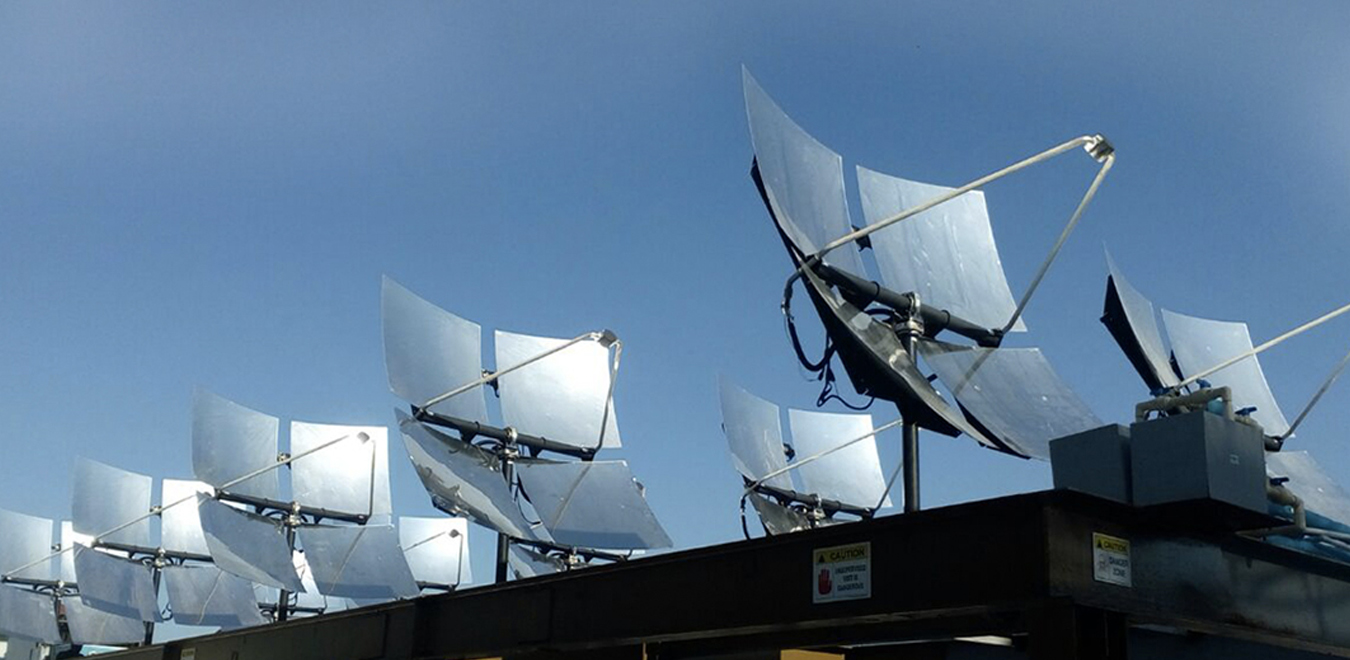
The EU-funded ASTEP project has been testing a “SunDial”—a rotary Fresnel solar collector—combined with Phase Change Material (PCM) storage. This system is designed to deliver heat at temperatures exceeding 150°C, with testing proving phase change stability at approximately 221°C . By pairing this with a high-response thermal store, ASTEP aims to provide continuous service, overcoming the intermittency of the sun to supply industries like steel and dairy processing, even at higher latitudes like Romania (47°N) .
Meanwhile, the SOLINDARITY project is pushing boundaries even further. By combining High Vacuum Flat Panels (capable of 150°C hot water) with a novel high-temperature heat pump, they aim to upgrade solar heat to a staggering 440°C using air as a medium. This opens the door for deep decarbonization in the rubber and paper industries, which require medium-grade heat for their processes .
4. The Role of Digital Intelligence (AI and Digital Twinning)
Modern solar heat is not just about hardware; it is about smart integration. A solar boiler doesn’t work if the sun isn’t shining, but factories need to run 24/7.
Projects like INDHEAP and SOLINDARITY are integrating AI-enabled process control and Digital Twinning to manage this mismatch. These systems forecast solar availability and optimize the balance between solar thermal, PV, heat pumps, and thermal energy storage (TES) . For example, the INDHEAP project features a flexible “e-TES” (thermal energy storage boosted by electric heaters) that decides the most rational and cost-effective way to use renewable energy throughout the day .
The Business Case: Real-World Proof
It is easy to get excited about technology, but does it make financial sense? Real-world pilots suggest yes.
Back in 2003, the International Institute for Energy Conservation (IIEC) helped BASF evaluate a solar boiler feed preheating system in India. By preheating feed water from ambient temperature to 65°C, the system was projected to save 110,000 kg of fuel oil annually, cutting CO2 emissions by 340 tons with a payback period of just 4.3 years (or 2.6 years with tax savings) . While that project is older, it established the fundamental economics that modern, more efficient systems are now improving upon.
Conclusion: A Bright, Hot Future
The industrial sector is at a turning point. As natural gas prices fluctuate and carbon taxes loom, “green heat” is moving from a niche concept to a core business strategy. Solar Hot Water Generator Solutions for Sustainable Industries


Leave A Comment