
The Power of the Sun at Scale: A Guide to Industrial Solar Hot Water Generators for Commercial Use
For decades, solar hot water systems have been the quiet workhorses of residential renewable energy, silently providing domestic hot water. But as businesses and industries face mounting pressure to decarbonize and slash operational costs, a more powerful evolution has taken center stage: the industrial solar hot water generator. These aren’t just larger versions of rooftop panels; they are sophisticated thermal powerhouses designed to meet the intense energy demands of commercial facilities, manufacturing plants, and large-scale institutions.
Whether you manage a hotel with endless demand for guest showers, a hospital requiring sterilization-grade heat, or a food processing plant needing precise temperatures for pasteurization, industrial solar thermal technology offers a path to energy independence and sustainability . In this post, we dive into the mechanics, benefits, and cutting-edge innovations shaping the future of commercial solar hot water.
Beyond PV: Understanding Solar Thermal vs. Solar Electric
When most people think of solar energy, they picture photovoltaic (PV) panels converting sunlight into electricity. However, solar thermal systems operate on a different, remarkably efficient principle: they capture the sun’s radiation and convert it directly into heat. While a standard PV panel might convert 15-20% of sunlight into electricity, a well-designed solar thermal collector can convert over 70% of solar energy into usable heat .
This distinction is crucial for industrial applications. Many commercial processes don’t primarily need electricity; they need heat—for washing, cleaning, space heating, or industrial processes. By generating heat directly, industrial solar water heaters bypass the inefficiencies of creating electricity only to convert it back into heat. This makes them exceptionally effective for decarbonizing “hard-to-electrify” sectors .
The Technology Behind the Heat: From Collectors to Process Heat
Industrial solar hot water generators are not one-size-fits-all. The technology is carefully selected based on the required temperature and the specific application. The market offers a spectrum of collector types, each suited for different industrial niches.
Flat-Plate Collectors (FPCs): The workhorses for low-to-medium temperature applications (up to ~100°C). They are robust, cost-effective, and ideal for preheating or providing hot water for spaces like hotels, community centers, and laundry facilities .
Evacuated Tube Collectors (ETCs) and Heat Pipe Collectors: These systems use a vacuum to insulate the absorber, making them highly efficient in colder climates and for achieving higher temperatures (up to 150°C). Their modular design allows for easy scalability, and “dry connection” heat pipes minimize maintenance and freeze risks, making them perfect for hospitals and schools .
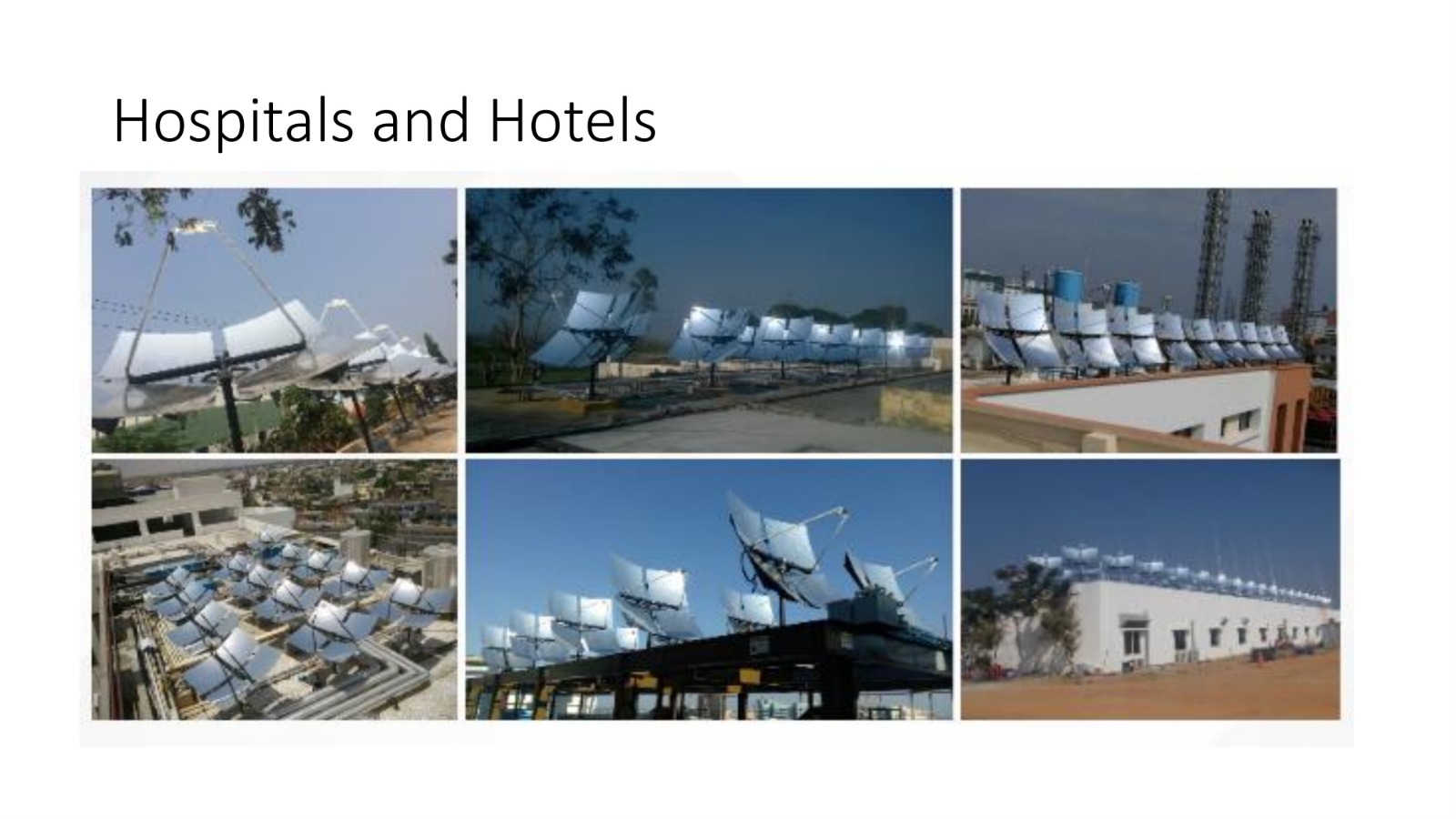
Concentrating Collectors (e.g., Parabolic Troughs): For heavy industry requiring high-temperature process heat—such as for dairy sterilization (up to 190°C), textile dyeing, or even bitumen heating—concentrating systems are used. They use mirrors to focus sunlight onto a receiver, achieving temperatures exceeding 400°C .
Real-World Impact: Where Commercial Solar Thermal Shines
The versatility of industrial solar hot water allows it to penetrate a vast array of sectors. Globally, the adoption of Solar Heat for Industrial Processes (SHIP) is accelerating, with over 1,300 systems operational by the end of 2024, representing a total thermal capacity of over 1,071 MW .
Here is how different sectors are harnessing this power:
Hospitality (Hotels & Resorts): Guest comfort demands 24/7 hot water. A 50-room hotel can save thousands annually by integrating solar thermal, offsetting 50-80% of its water heating costs .
Healthcare (Hospitals & Clinics): From sterilization to patient bathing, the demand for continuous, reliable hot water is critical. Solar thermal systems reduce reliance on fossil fuel boilers, cutting emissions and operational risk .
Food and Beverage Industry: This sector uses significant heat for pasteurizing, blanching, and cleaning. Solar process heat can be integrated directly into production lines, providing a predictable and low-cost energy source .
Agriculture: Dairy farms require hot water for cleaning milking equipment, and greenhouses need consistent temperatures. Hybrid solar systems are now being deployed to support year-round farming, even in colder latitudes .
The New Wave of Innovation: Hybrid Systems and PVT
The industry is not standing still. Two major trends are revolutionizing how commercial entities capture solar energy.
The first is the rise of sophisticated integration. Companies are moving away from bespoke, complex designs to packaged solutions. For example, systems now integrate solar thermal with highly efficient electric boilers and smart controls, ensuring a consistent supply of water at safe temperatures (up to 65°C) year-round, regardless of solar fluctuations .
The second, and perhaps most exciting, innovation is the emergence of hybrid Photovoltaic-Thermal (PVT) systems . These groundbreaking panels are effectively “two-for-one” units. They generate electricity while simultaneously capturing waste heat from the PV cells to produce hot water. By combining both streams, a single PVT panel can produce up to four times the energy output of a standard PV panel or thermal collector alone . The thermal component also cools the PV cells, improving their electrical efficiency—a win-win scenario for commercial buildings with limited roof space .
The Financial and Environmental Case
For commercial decision-makers, the bottom line is critical. While the initial capital expenditure for an industrial solar hot water generator can be higher than a conventional gas boiler, the long-term economics are compelling.
Predictable Energy Costs: Solar energy provides a hedge against volatile fossil fuel prices. Some systems offer a predictable levelized cost of energy (LCOE) as low as €0.05/kWh over 20 years .
Rapid Payback: Depending on the application and local fuel costs, payback periods typically range from four to eight years . After that, the heat is essentially free.
Substantial Carbon Reduction: A commercial system can actively cut carbon by approximately 148 kg of CO2 per square meter of collector installed annually . This makes a significant dent in a company’s Scope 1 emissions.
Resilience and Autonomy: Many modern systems are designed to be fully autonomous, operating without batteries or a grid connection. This is invaluable for remote infrastructure, off-grid buildings, or facilities aiming for true energy resilience .
Conclusion
Industrial solar hot water generators have moved from a niche technology to a mainstream commercial strategy. With advancements in collector efficiency, the advent of hybrid PVT systems, and a global push toward decarbonization, the sun is now a viable and powerful fuel source for industry. Whether through a simple flat-plate preheat system or a high-temperature concentrating array, businesses can capture the sun’s warmth to drive their operations, stabilize their energy bills, and meet their sustainability goals. The age of solar heat is here.


Leave A Comment