
The Sun on a Plate: Why Concentrating Solar Thermal (CST) Dishes are the Future of Industrial Heat
If you have ever used a magnifying glass to burn a leaf on a sunny day, you already understand the basic principle behind Concentrating Solar Thermal (CST) dishes. You took a large surface area of sunlight and focused it into a single, intensely hot point. Now, imagine doing that with mirrors polished to perfection, tracked by computers, and engineered to power a hospital, a dairy, or even a car factory.
That is exactly what we do at Quadsun Technology. While the world is obsessed with standard solar panels, we have been quietly perfecting the art of bending light to create something far more valuable for industry: reliable, high-temperature process heat.
Let’s take a deep dive into how these parabolic marvels work and why they might just be the missing piece in your sustainability puzzle.
What Exactly is a CST Dish?
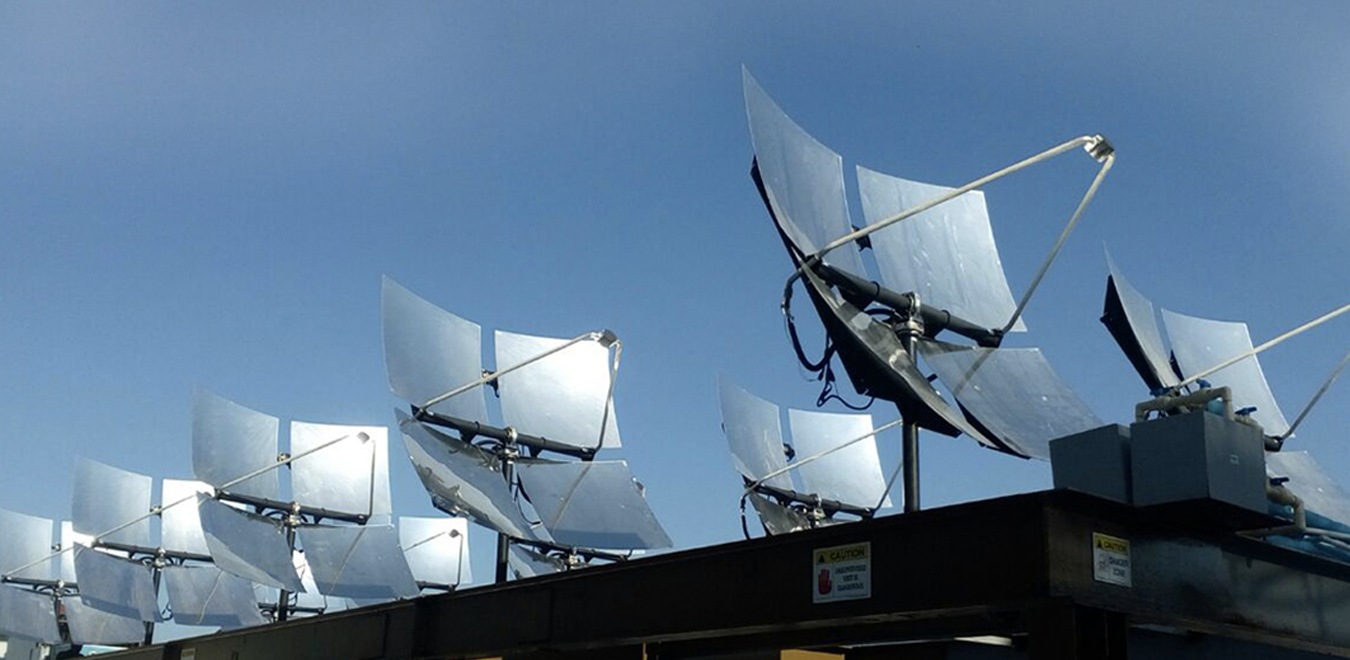
Think of a CST dish as a highly sophisticated satellite dish, but instead of listening to signals from space, it’s shouting them back at the sun. Also known as a Parabolic Dish Concentrator, these systems use a dish-shaped surface covered in reflective mirrors to direct and concentrate sunlight onto a specific focal point. Concentric Solar Thermal ( CST ) Dishes
Unlike flat photovoltaic (PV) panels that convert light directly into electricity, CST dishes capture the sun’s thermal energy. They generate the one thing heavy industries cannot live without: heat.
At Quadsun, our flagship technology is designed to make that heat as intense as possible. We use highly accurate mirrors to focus sunlight sharply onto our receivers, achieving a concentration ratio of up to 700 to 800 times. To put that in perspective, our receiver is essentially looking at a sun that is 800 times brighter than the one you see in the sky.
The Anatomy of a Solar Dish
A CST system is a beautiful intersection of physics, mechanics, and software. It relies on a few key components working in perfect harmony:
The Concentrator (The Dish): This is the large, parabolic structure that holds the mirrors. Its job is to collect sunlight from a wide area and reflect it to a single point. The shape is critical—any imperfection and the light scatters. Concentric Solar Thermal ( CST ) Dishes
The Receiver (The Target): Hovering at the focal point of the dish is the receiver. This houses the absorber, which captures the concentrated beam of solar energy and converts it into usable heat.
The Tracker (The Brain): The sun moves, so the dish must move with it. Our systems use dual-axis tracking powered by sophisticated electronics and software to ensure the dish is always pointing directly at the sun. This keeps the focal point locked in place from sunrise to sunset.
The System Controller (The Conductor): This is the electronics hub that manages the tracking, monitors the system’s health, and interfaces with your existing facility.
From Sunlight to Steam: How It Works
The magic happens when these components align. As the dual-axis tracker moves the dish, the mirrors capture direct sunlight and reflect it onto the receiver. Inside that receiver, the concentrated energy is converted into heat, which is then transferred to a heat-transfer fluid (usually water or thermal oil).
This is where the “Concentrating” part pays off. Because the energy is so focused, we can achieve much higher temperatures than standard flat-plate collectors. This heated fluid can then be used for a massive variety of applications:
Process Heat: Pre-heating boiler feed water or generating steam for industrial processes.
Hot Water: Supplying large volumes of hot water for hospitals, hotels, or hostels.
High-Temperature Tasks: Driving steam cooking, agricultural drying, and even solar air-conditioning through absorption chillers.
Because of this high concentration and precision tracking, our systems produce up to 400 percent more energy per unit area than non-tracking solar technologies, all while using half the space.
Who is Using This Technology Right Now?
CST dishes aren’t a science experiment; they are a proven commercial solution. The industrial market potential for CST in India alone is estimated at around 6.45 GWth. That is a massive appetite for clean heat.
Here is where you will find our dishes in action:
Healthcare: Hospitals like Manipal and Apollo use our CST systems to meet their massive hot water demands, slashing electricity bills while ensuring hygiene.
Automotive: We installed small dual-axis tracking dishes on the roof of the Honda Motorcycle factory in Narsapura to provide solar process heat for their manufacturing lines.
Industrial Giants: Major corporations like ITC and IFFCO trust our technology to decarbonize their heating needs.
The Bigger Picture: Why Heat Matters More Than Electricity
Here is a reality check that most people miss: approximately 80% of industrial energy consumption is powered by burning coal, natural gas, and petroleum products just to create heat.
Standard solar panels are great for running lights and laptops, but they struggle to run a dairy pasteurizer or a chemical reactor. That is the gap that CST dishes fill. They provide the medium-temperature heat (below 400°C) that industry runs on.
Furthermore, the global market for solar concentrators is expected to double from $1.5 Billion to $3.2 Billion by 2033, with Parabolic Dish Collectors leading the market share at 42%. The world is finally realizing that you cannot have a green economy without green heat.
Is a CST Dish Right for You?
If your business relies on steam, hot water, or hot air during daylight hours, the answer is almost certainly yes.
Whether you need to heat 8,000 liters of water for a hospital or provide pre-heated boiler feed water for a factory, CST dishes offer the highest efficiency in the smallest footprint. They reduce your reliance on fossil fuels, protect you from volatile energy prices, and dramatically lower your carbon footprint.
At Quadsun, we don’t just sell hardware; we deliver integrated energy solutions backed by innovations in optics, mechanics, thermodynamics, and tracking algorithms.
The sun is the most abundant fuel source on the planet. It’s time we started using it to power the heavy lifting. Concentric Solar Thermal ( CST ) Dishes
Ready to focus on a cleaner future? Contact Quadsun Technology today to see if a CST Dish solution is right for your facility.


Leave A Comment