Beyond Zero: How Smart Zero Liquid Discharge Solutions Are Redefining Indian Manufacturing
Ask any plant manager in India’s industrial heartland what keeps them up at night, and you will hear the same answer again and again. Water.
Not just the fear of running out of it. But the growing mountain of regulations, the rising cost of freshwater, and the nagging question of what to do with all that effluent leaving your facility every single day.
For years, the answer seemed simple. Treat your wastewater just enough to meet basic discharge norms and send it down the drain. But those days are over. The ground beneath our feet has shifted.
Welcome to the era of Zero Liquid Discharge (ZLD) —a world where no industrial wastewater leaves your facility, every drop is recovered and reused, and your environmental compliance becomes a competitive advantage instead of a burden.
Let us break down what ZLD actually means, why it is no longer optional for Indian industry, and how Quadsun Technology is making it more affordable than you might think.
What Exactly is Zero Liquid Discharge?
Here is the simplest way to understand ZLD. Imagine taking every liter of wastewater your factory produces and running it through a series of increasingly sophisticated treatment steps until nothing liquid remains. The water comes out clean enough to reuse in your boilers or cooling towers. The contaminants are concentrated into dry solids that can be safely disposed of or, in some cases, even sold as byproducts.
That is ZLD in a nutshell. A closed-loop system that eliminates liquid waste discharge entirely. Zero Liquid Disscharge Solutions
At its core, a conventional ZLD system follows a four-step journey:
Step One: Pre-treatment. The raw effluent goes through clarifiers and chemical feed systems that precipitate out metals, hardness, and suspended solids. This step protects everything downstream from scaling and fouling.
Step Two: Membrane concentration. Technologies like reverse osmosis (RO) and ultrafiltration separate clean permeate from concentrated brine. This stage typically recovers 60 to 80 percent of the water.
Step Three: Thermal evaporation. The reject stream from the RO system enters a multi-effect evaporator (MEE) or a mechanical vapor recompression (MVR) unit. Here, heat is applied to vaporize the remaining water, which is then condensed and collected for reuse.
Step Four: Crystallization. The final concentrate goes through a crystallizer that boils off every last drop of liquid. What remains is a dry, solid cake that can be disposed of safely in a landfill or, in some industries, recovered as valuable salts like sodium chloride or ammonium sulfate.
When fully optimized, a well-designed ZLD plant can recover 95 to 99 percent of your effluent water and return it to your process.
Why ZLD is No Longer Optional in India
Here is the reality check that every industrial leader needs to hear. ZLD used to be a badge of honor—something progressive companies voluntarily adopted to demonstrate environmental leadership. But as we move through 2026, the landscape has changed completely.
The Central Pollution Control Board (CPCB) has moved far beyond simple end-of-pipe monitoring. Under the new Extended User Responsibility (EUR) framework, industries that extract groundwater or draw from municipal supplies must now demonstrate specific percentages of water neutrality. A functioning ZLD system is the most direct path to achieving that status.
For industries located in designated over-exploited groundwater zones—the so-called “Red Zones”—ZLD is effectively becoming a prerequisite for obtaining or renewing your Consolidated Consent and Authorisation (CCA). Fail to implement a verified ZLD system, and you risk immediate closure notices.
The numbers tell the story. The India Zero Liquid Discharge Systems Market was valued at USD 1.14 billion in 2024 and is projected to reach USD 1.84 billion by 2030, growing at a compound annual rate of 8.10 percent. This is not a niche market. This is mainstream industrial infrastructure.
And industries are responding. According to the latest ICRA ESG Ratings report, nearly 74 percent of textile companies have now adopted Zero Liquid Discharge systems, marking one of the sector’s most ambitious transitions toward sustainable water management.
But here is the problem that nobody talks about.
The Hidden Challenge: Energy Consumption
Conventional ZLD systems have a dirty little secret. They consume enormous amounts of energy.
Those multi-effect evaporators and crystallizers run on steam and electricity. And in most Indian factories, that steam comes from coal-fired boilers, and that electricity comes from a grid still heavily dependent on fossil fuels. Zero Liquid Disscharge Solutions
Industry estimates suggest that steam and electricity account for 90 to 95 percent of the operating costs of a typical ZLD plant. And those costs are not trivial. The energy required to run conventional evaporation and crystallization systems typically ranges from 30 to 120 kilowatt-hours per cubic meter of water treated.
For a facility processing 100 kiloliters of reject effluent per day, operating costs can run as high as ₹1,100 per kiloliter. That translates to over ₹1.75 crore in annual operating expenses just for the thermal stages of ZLD treatment.
So here is the paradox. You install a ZLD system to solve your water problem and reduce your environmental footprint. But in doing so, you dramatically increase your energy consumption and carbon emissions. You close the water loop while widening the carbon loop.
There has to be a better way.
The Quadsun Difference: Solar-Powered Evaporation
At Quadsun Technology, we have spent years asking that exact question. And we believe we have found the answer.
Our patented intelligent evaporation technology takes a radically different approach to the most energy-intensive stage of ZLD treatment: the evaporation step. Instead of relying on grid electricity or fossil-fuel-generated steam, our systems harness the power of the sun.
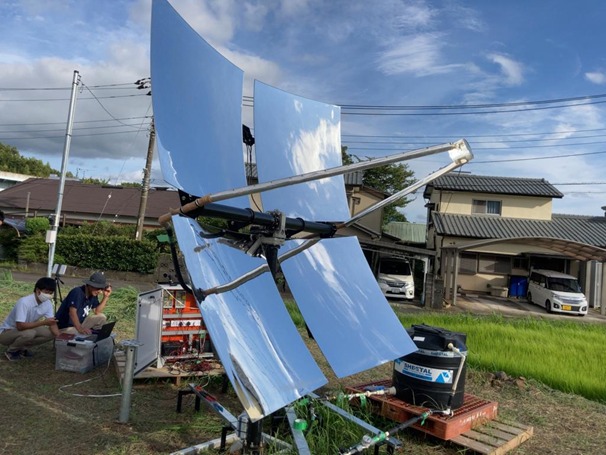
Here is how it works. Our concentrated solar thermal (CST) dishes capture and focus sunlight onto a receiver, generating high-temperature heat without burning any fuel. That thermal energy is then transferred to our custom-designed evaporators, where wastewater is heated and vaporized. The vapor is condensed into clean, distilled water ready for reuse in your facility. The contaminants remain behind as solid residue.
The results speak for themselves. Compared to conventional metallic evaporators—the multi-effect evaporators (MEE) and agitated thin film dryers (ATFD) that dominate the industry—Quadsun’s intelligent evaporation systems operate at less than 90 percent of the energy cost.
We are not just talking about incremental improvements. We are talking about a fundamental rethinking of how ZLD should work in a sun-rich country like India.
And we are not doing it alone. Quadsun has partnered with RealZLD™ , a joint venture that integrates Salinity Solutions’ HyBatch™ high-efficiency reverse osmosis technology with our convection-enhanced evaporation technology. Together, these two patented systems deliver a ZLD solution that offers up to 98 percent wastewater recovery while using 90 percent less energy than competing technologies.
The first customer to install this solution? Bosch, at their Bidadi automotive plant near Bengaluru. If one of the world’s most demanding manufacturers trusts this technology, that tells you everything you need to know about its reliability and performance.
The Bigger Picture: Water Scarcity and the Economics of ZLD
To understand why ZLD is not just an environmental imperative but a financial one, you need to understand India’s water reality.
The numbers are sobering. India is home to 18 percent of the world’s population but has access to only 4 percent of its global freshwater resources. Per capita water availability has plummeted from around 5,177 cubic meters in 1951 to approximately 1,500 cubic meters today—well below the water scarcity threshold of 1,700 cubic meters.
By 2030, India’s water demand is projected to exceed supply by nearly 50 percent. That is not a distant environmental concern. That is a near-term business risk.
Industries that adopt ZLD are not just complying with regulations. They are future-proofing their operations against drought-induced shutdowns, water price volatility, and regulatory penalties.
The financial case is compelling. A ZLD system that recovers 95 to 99 percent of effluent water generates ROI through two distinct channels. First, direct cost savings from reduced freshwater procurement—upwards of ₹1.2 crore annually for a manufacturer with substantial water consumption. Second, avoided costs from eliminated regulatory fines, which can run to ₹5,000 daily and ₹1 lakh in significant penalties, and protected operational continuity against the risk of factory shutdown.
The payback period for a well-designed ZLD system is typically 2 to 3 years. And that is using conventional technology. With Quadsun’s solar-powered approach, which dramatically reduces the energy component of operating costs, the return on investment becomes even more attractive.
Who Needs ZLD? Industries Already Making the Switch
Zero Liquid Discharge is not theoretical. It is already transforming industries across India.
Textiles lead the way. The sector has embraced ZLD at remarkable scale, driven by the concentration of dyeing and processing units in water-stressed regions like Tirupur, Ahmedabad, Surat, Ludhiana, and Pali. The mandate is clear: recover every drop of water and every gram of salt from the dyeing process.
Pharmaceuticals are another major adopter. ZLD is critical for treating complex effluent streams containing solvents and active pharmaceutical ingredients that cannot be discharged into the environment. Mylan’s ZLD facilities have been operating successfully since 2009, proving the long-term viability of the approach.
Chemicals and petrochemicals, power generation, food and beverage, and electronics manufacturing round out the list of sectors where ZLD is becoming standard practice.
But here is the challenge that remains. Conventional ZLD architectures involve substantial capital investment, high energy use, and complex chemical handling. For the micro and small enterprises that dominate many of these sectors, traditional systems are often financially out of reach.
That is precisely where Quadsun’s approach offers a breakthrough. By replacing energy-intensive thermal evaporation with solar-powered technology, we lower the operating cost barrier that has kept ZLD out of reach for smaller players.
The Future: ZLD as a Strategic Asset
Here is the mindset shift that separates the leaders from the followers in Indian industry today.
Stop thinking of ZLD as a compliance cost. Start thinking of it as a strategic asset.
A properly designed ZLD system secures your water supply against droughts and shortages. It stabilizes your operating costs by insulating you from volatile water prices. It eliminates regulatory risk entirely, protecting your license to operate. And in an era where ESG ratings increasingly determine access to capital and customer contracts, it delivers measurable improvements to your sustainability profile.
With the European Union’s Carbon Border Adjustment Mechanism (CBAM) set to impose stricter scrutiny on carbon-intensive imports, Indian manufacturers face rising competitiveness risks unless they accelerate their decarbonisation journey. ZLD is not just about water. It is about positioning your business to compete in a carbon-constrained world. Zero Liquid Disscharge Solutions
Ready to Close Your Loop?
Zero Liquid Discharge is no longer a distant aspiration. It is the new baseline for responsible industrial operations in India. And with Quadsun’s solar-powered evaporation technology, achieving ZLD no longer means choosing between water sustainability and energy affordability.
Whether you operate a textile dyeing unit in Tirupur, a pharmaceutical plant in Hyderabad, or an automotive factory in Pune, we have the technology and expertise to help you close your water loop—without breaking the bank or blowing your carbon budget. Zero Liquid Disscharge Solutions
Take the first step toward water independence today.
📞 Contact Quadsun Technology for a comprehensive assessment of your facility’s ZLD potential. Our team will analyze your effluent streams, evaluate treatment options, and provide a clear roadmap to Zero Liquid Discharge that makes financial and environmental sense.
Visit our website or reach out to schedule a consultation. Because in a water-scarce world, the businesses that close the loop will be the ones that thrive. Zero Liquid Disscharge Solutions
Quadsun Technology — Powering India’s transition to sustainable, zero-discharge industrial operations.


Leave A Comment